
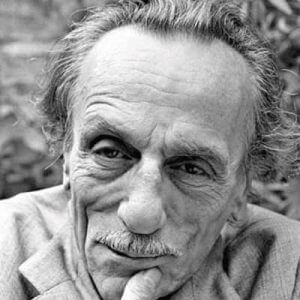
Eduardo De Filippo ©️ public domain
Once upon a time, a long time before we were all born, an Italian performer, playwright and screenwriter by the name of Eduardo De Filippo was changing the world of theatre for good.
Born in Naples in 1900 from the affair between an affluent playwright and a dressmaker, he authored the immensely popular theatre plays Side Street Story, Natale in Casa Cupiello [Christmas at the Cupiello’s] and Filumena Marturano. The latter also inspired the 1964 Oscar-nominated film Marriage Italian Style by Vittorio De Sica starring Sophia Loren.
Eduardo De Filippo is still regarded as one of the country’s foremost storytellers of all time, and his over 50 plays documented the history of Southern Italian society like nothing else. He died in 1984.

Vincenzo Salemme – © to the owners
The actor interviewed today is among the very few contemporary performers who had the honour of being mentored by Eduardo De Filippo in person before he died, and he treasures lots of precious memories from his time with the Maestro.
Vincenzo Salemme started his career as a professional stage actor in the 1970s, aged about 20, in Eduardo De Filippo’s theatre company in Naples and – not because of that but in addition to that, he has been working his way up into the Italian entertainment industry for decades, now.
Today, he is one of the most talented and appreciated performers and playwrights in the country.
Vincenzo, what have you learned from your time with Eduardo De Filippo?
It was more than just one lesson; it was more of a way of approaching our profession. This is what I learned. I am not trying to be like him, but I try to approach the job in the way he seemed to be doing, in the most authentic way I possibly can. I think people should be honest regarding this; they shouldn’t pretend they are somebody they are not. I don’t want to appear smarter than I really am, or anything like that. I believe theatre audiences can tell if you are true to yourself as a performer, or not. Sometimes little children come up to me to say that they enjoyed my movies, which are actually adult movies – I mean, not adult in the porn meaning of it – but I think most of them are meant for an older audience. And in the end, children still love these films. Then well, maybe at some point in life, we all decide we would prefer to be someone else, and actors may end up not even performing, but actually picking a role for themselves. And maybe this is right, as our unconscious self is so diverse that we eventually have to decide for ourselves.
Is this the reason why you became an actor?
I believe the reason I am an actor is that I have never been able to choose what I wanted to be in life, so I told myself, OK, I am just going to be myself, I am just going to say what I think, and then those who love me will accept me anyway. I think being an actor is something really difficult, it’s all about freedom, as actors are the only creatures that can repeat the same thing over and over again without being influenced because that thing is not real. But as a working actor, I realise I can’t always be free. Life itself doesn’t have real freedom in it because we are all influenced by everything: by the sun’s position in your birth charts, by the winds, by wars… we are influenced all the time by everything. Freedom is pure utopia, is non-existent, and we cannot do whatever we want every single day, because every day something different will happen and we’ll be forced to change our path. If you think about it, actors are the only ones who can actually take the same path every single day, even though it is impossible even for them. I often get asked how I can do the same identical performance on stage every single day, but in truth, I never do exactly the same thing. Even those who do nothing but classical plays and are supposed to only repeat the same sentence with the same voice – well, I tell you that it’s never exactly the same. So, I prefer breaking the taboo and letting the play come into my life, into my days and into my state of mind. For me, the “before” and “after” of a show don’t really exist; what does exist is that now I’m talking with you, then when I’m finishing this conversation I’m sitting there eating some chocolate, then I’ll make a phone call and so on, and then I go on stage and I do my show, and every time I try to put on a show as if it was the first time.
What are the pros and cons of being an actor?
When you’re just starting out, it’s going to be incredibly hard. You may attend acting school and see your name, plus the word “actor”, printed somewhere, but it’s still extremely hard to find work, as you’ll need to do loads and loads of auditions. There are a lot of TV and cinema productions being made today, but not enough theatre, so it’s easier to break on the screen before you even start acting on the stage – but to me, the real difference for a budding actor actually is theatre. And so the cons is that there’s not enough theatre being made, so what I would suggest to young people is not to lose their strength of spirit, to carry on and try and work in theatre before doing all the rest.
What do you think of the rise and fall of the Italian film industry and Cinecittà Studios?
This all depends on how the movie industry works. Cinecittà Studios were working well in the past because it was cheap for American productions to come and shoot their movies in Rome; if you make it convenient for them again to make films in Italy, then this could become a good deal again, even if making movies in studios is considered a bit old-fashioned nowadays. I’m not an expert, but I know that there are different types of financial investments and a lot of money is spent on the movies of Giuseppe Tornatore and Paolo Sorrentino and other big productions made to compete at the Academy Awards, but then the rest of the industry is pretty low-cost. Smaller productions can’t really compete internationally, whereas Italian cinema should all be high-quality, in my opinion.
What should people know about Neapolitan theatre tradition and plays?
Supporting the arts within Italy represents a challenge; all the different governments we’ve had over the years – and I’m in my sixties as we speak, so I witnessed a lot going on in politics – only financed and supported a type of “posh” entertainment, perhaps forgetting about Italy’s cultural heritage. So, getting local theatre plays to travel across Italy is already very difficult, and so I wouldn’t know how you could promote them abroad. I think it would be even more complicated. For me, Neapolitan as a language is very, very important. Then, of course, we should speak in a language that everyone can understand. As Eduardo taught me, when I’m not in Naples, I need to italianise Neapolitan words to get the message across. But there is much more than that: timing, harmony, sense of humour – there’s a lot of stuff that actually makes a good theatre play, it’s not all about the language you use. I’m not really worried about languages, as they change and evolve, and that’s normal; what I’m worried about is that our theatrical heritage is being lost, which is a great shame, as this is what makes people laugh; sense of humour should be regarded as tradition, not avant-garde. Whether you make comedy or drama, I really believe that you need to move people; it doesn’t matter whether you do it by making them laugh or cry. You need to move them one way or another, and both things should be considered equally important and worthy of attention.
You got your A-Levels* in Italian, Latin, Greek and Classical Civilisation [Liceo Classico] – what was your dream job as a child?
Well, to be honest, I still would like to do any kind of job, even being an astronaut. But I’ve always liked being an actor. Ever since I was very little, I would make impressions and imitate people. For example, instead of the typical Christmas letters to my parents, I would summarise what had happened in the year, and I would play all the characters in the family, such as my mum and dad, by putting on a little show after dinner at Christmas. Theatre has always been my passion, even though when I was really really young I was dreaming of being a house painter. We were renovating the house at the time and we had lots of painters around, and this is something I still enjoy – I really like having workmen at my place. My grandfather was a bricklayer and would often bring me along to the construction sites. I enjoyed so much the smell of concrete mixed with the smell of those sandwiches we had for lunch – mostly sandwiches with aubergines and red peppers! This was a wonderful moment for me. I remember those white shirts the workmen were wearing. It was the 1960s, and it was a great time. I was about 5 years old.
Is it true that, when you were 5, you fell in love with a nun called Sister Angelina?
Sister Angelina was there when I was attending this Catholic school, and yes, I fell in love with her, and I insisted on bringing her flowers when I was about to leave to go to primary school. I forced my mum to buy flowers for Sister Angelina, whom I saw as an old lady at the time… but then I found out she was only like 16 or 17. She was a very young nun!
You once said that it takes 40 years of life to be a child again.
Yes, I think it’s actually like that. We search and search for what we used to be as kids; when I write a new play, I usually do it straight away, in just one or two days. Then, I’m forced to change it and change it again for practical reasons, but in the end, the strongest idea was always the first one – it’s like James Joyce’s Ulysses: we go to travel and travel and see the mermaids… just to go back to the starting point in the end.
Have you ever thought of becoming a football player?
Haha, no, I played football, but I was crap at it… mamma mia, but I insisted on football, although I think I might have liked being a football coach instead. I also loved Athletics, I liked [the late Italian sprinter, winner of a gold medal at the 1980 Moscow Olympics] Pietro Mennea, and when he set a world record in 1979, I cried in front of the telly. I like Athletics and I like sports in general. Or maybe I would have enjoyed my father’s job, he was a defence attorney.
Wouldn’t you have made the court laugh?
Ehe, maybe! You know, at some point in my life, I needed therapy, and my very old psychiatrist just couldn’t stop laughing at me. He was over 80 and he told me that this had never happened to him before. So, unfortunately, I was making him laugh out loud.
How do you protect your right to be sad?
Well, I’ve got a house. And I can be whoever I want to be when I’m home. And when I’m out and about, I just try not to be sad.
Unless stated otherwise, pictures were provided from Vincenzo Salemme’s private collection © belongs to their respective owners